Tony Ingrao and the priory of Saint-Symphorien
Excerpt from a passage from the book “The priory of Saint-Symphorien, a thousand-year history”
“Different needs, different translations”
This is what could define the state of mind of Tony Ingrao whose numerous achievements around the world strike us with their diversity and originality. Marked by the style of the Grand Siècle, the achievements of contemporary architects such as Tadao Ando or Franck Gehry, but also imbued with European culture (he is part of the family of Italian resistance fighter Pietro Ingrao, one of the founders of the PCI), Tony Ingrao began his career by retracing the steps of his childhood, in Bonnieux, where his maternal grandmother ran a grocery store.
At the end of his architectural studies, he went to Paris in the early 1980s to study Fine Arts and there met Daniel Vial who allowed him to carry out his very first architectural project. He remembers being struck by the light of Provence, which inspired so many artists, painters and writers marked by its almost blinding brilliance and its changing moods. Walking in the Luberon was a real sensory experience for him. The sun, the dryness of this land mixed with limestone, the scents of lavender, almond blossoms, the whisper of the wind in the cypresses, the olive trees... all these elements were part of an enchanting world which captivated the young architect. In the middle of this setting, at the bend of a road winding along the side of the rock, the Aiguebrun valley opened up and swirled, until he saw, standing straight towards the sky, the tower of the Priory, seeming to escape the impact of time.
“I was struck by the energy that emanated from this monument, it was for me an extraordinary project, I wanted above all to respect this monument, the purity of its lines, its mineral aspect”
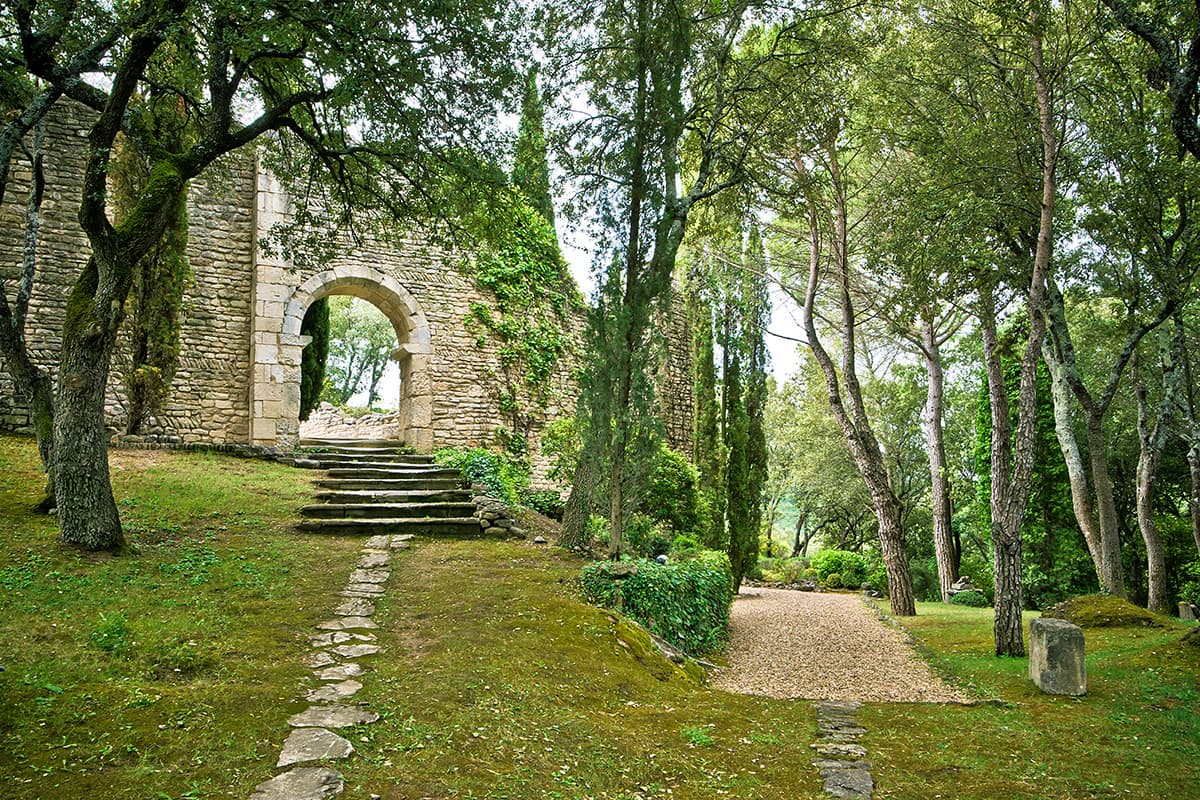
Tony Ingrao opted for a refined interior design, preserving the monastic atmosphere, whose materials would come directly from the region (natural pigments from the lands of Roussillon, cut stones recovered directly on site, terracotta tiles from Apt). Above all, in order not to distort the monument, it was necessary to opt for a sober decoration, mixing stone and wood (Provençal sideboard, wooden four-poster bed from a monastery not far from Avignon, old stone paving). The garden was mainly made up of plants and trees from the region (cypress, olive trees, thyme, rosemary, lavender), the mineral aspect was also highlighted (stone walls and stairs).
“I still have a very present memory of the Priory which was a real challenge for me: that of transforming a medieval priory into a welcoming, warm place where one can withdraw from the world”