Second half of the 5th century
Construction in Marseille of a basilica dedicated to the martyr Saint Victor
Founded by Saint Cassian in honor of Saint Victor, a 3rd-century martyr, destroyed by the Saracens, the church was rebuilt around 1040. Inside, a crypt and catacombs have served as necropolises since Late Antiquity, including ancient pagan and Christian sarcophagi. Every year at Candlemas, the Black Madonna venerated since the 13th century is carried in procession through the city. These are Marseille’s most important traditional religious celebrations.
Late 6th century
Attestation of the cult of the martyr Victor by the historian Gregory of Tours.
Late 8th century
First attestation of a monastery on the site of Saint Victor of Marseille.
977
Arrival at the monastery of Saint Victor of Marseille of a community of monks living according to the Rule of Saint Benedict.
Early Middle Ages
A necropolis predates the establishment of the church of Saint-Symphorien.
Year 1000
Saint-Symphorien is a private family church belonging to the Lacoste-Castellane family, one of Provence’s most powerful lineages.
1053
Donation of the church of Saint-Symphorien by the brothers Pons and Ripert (Lacoste-Castellane) to the Abbey of Saint Victor of Marseille. At that time, Provence was part of the Holy Roman Empire.
Early 12th century
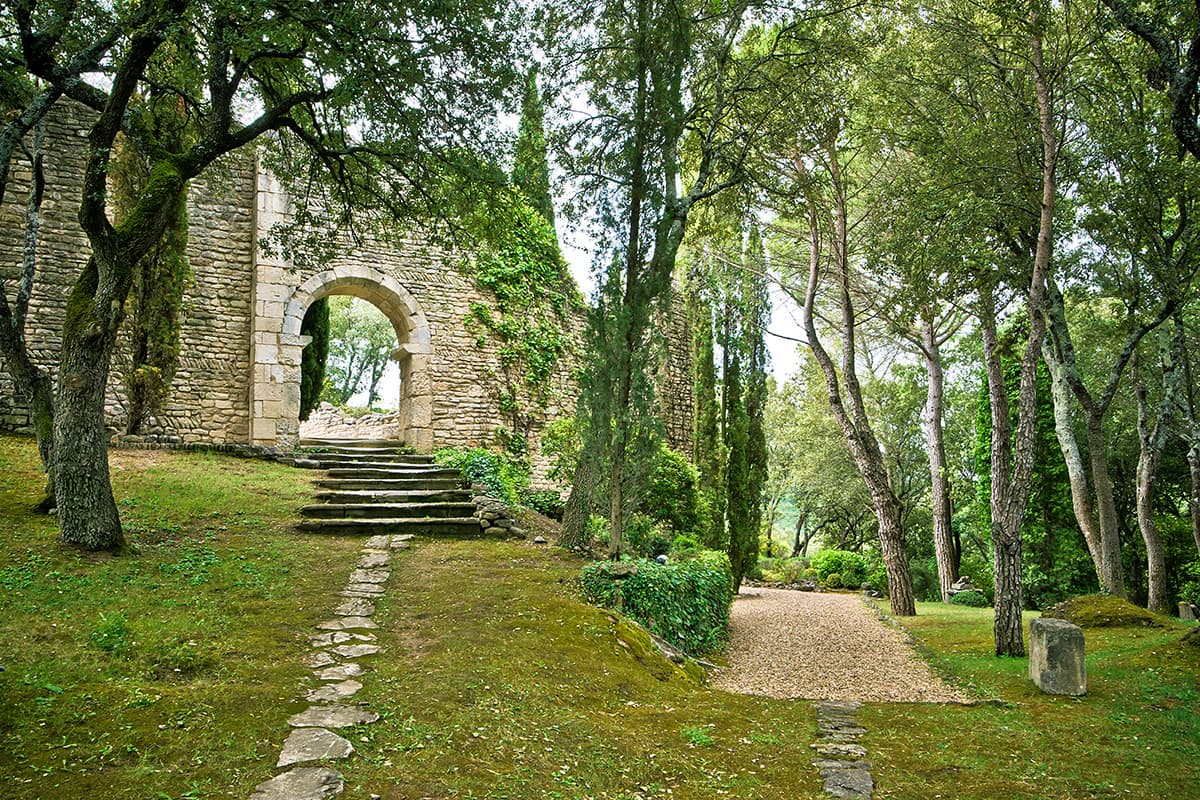
A community of Benedictine monks took possession of the site and made many transformations to the building from the beginning of the 12th century. The original church was reintegrated into the priory complex as a monastic church. Attached to it, to the south, a second church was built for the faithful. The domestic building housing the monastic community was built in front of the western façade of the original church. This period also saw the construction of an enclosure and the remarkable bell tower that still dominates the Aiguebrun valley.
Pons Farald donated all the inheritance he owned in the territory of Saint-Symphorien (gardens, cultivated and uncultivated lands, mills) to the monks living there. Inguilbert was then the prior in charge of managing the Priory.
1274
Bonnieux then became part of the Comtat Venaissin, an enclave among the lands of the Count of Provence, Charles I of Anjou, directly under the Pope’s authority.
14th century
Saint-Symphorien became a small church intended for nearby populations. The site below the Priory, deserted at the end of the 12th century, was then reoccupied. Nearby, Avignon became from 1309 onward the seat of the papacy. Seven popes succeeded one another until the end of the century: Clement V (1305-1314), John XXII (1316-1334), Benedict XII (1334-1342), Clement VI (1342-1352), Innocent VI (1352-1362), Urban V (1362-1370) and Gregory XI (1370-1378).
End of Louis XIV’s reign
Saint-Symphorien became a hermitage.
1713
In 1713 it hosted Joseph-Ignace de Foresta, bishop and prince of Apt, who wished to live there in solitude.
18th century
Many works financed by the community of Bonnieux were carried out on the bell tower to consolidate and protect it from bad weather.
1782
The municipal council of Bonnieux decided to place the city’s coat of arms above the gate of Saint-Symphorien. The key depicted on the arms is a reminder of pontifical domination. Bonnieux was only attached to the Kingdom of France in 1791.
1795
Saint-Symphorien was sold as national property to a farmer from Bonnieux, Julien Roch, for 200 livres.
19th century
The population of Bonnieux went to Saint-Symphorien to celebrate the patron saint’s feast on August 22. Little by little this tradition was abandoned, and the feast moved to Bonnieux.
1835
Writer and historian Prosper Mérimée, then Inspector General of Historic Monuments, noticed the Priory tower and described it in his Notes d’un voyage dans le Midi de la France.
Late 19th century
The Priory was a farm; one could still see the ruins of the 12th-century enclosure and the staircase leading to the north chapel tribune. The tower was used as a dovecote.
1921
Listing of the Saint-Symphorien bell tower as a Historic Monument. In the mid-20th century, the Priory gradually fell into ruin.
1951
Restoration of the bell tower.
1972
A first archaeological excavation campaign was organized, led by Michel Fixot and Isabelle Barbier.
1979
Daniel Vial bought the Priory from Marie-Antoinette Ardilouze, mother of Roger Vadim. He undertook a vast restoration and redevelopment program throughout the 1980s alongside Dominique Ronsseray and Tony Ingrao.
1983
A second excavation campaign was organized, led by Michel Fixot and Isabelle Barbier.
1992-1993
A third excavation campaign took place, led by François Guyonnet, to pursue previous discoveries by studying the semi-rock dwellings below the Priory.
2014-2015
Publication of a book on the Priory recounting the main stages of the monument’s life, Le prieuré de Saint-Symphorien, une histoire de mille ans, directed by Julia Moraine. Creation of the website.
2023
Website update.